316L Vs 304 Stainless: The Ultimate Marine Grade Guide
In the marine hardware industry, the ocean is an unforgiving proving ground. While many commercial manufacturers offer AISI 304 stainless steel as a “cost-effective” solution, maritime environments quickly expose its fatal flaws. At RYMAR Forge, we adhere to a strict standard: for saltwater applications, it’s AISI 316L or nothing.
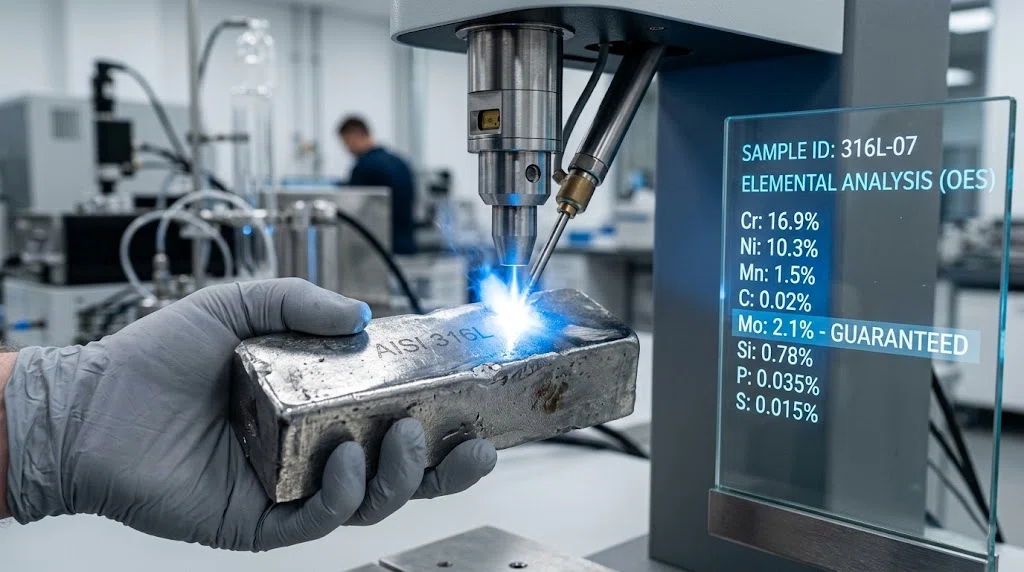
Fig 1: Surface integrity of AISI 316L vs AISI 304 after simulated offshore exposure.
The Invisible Threat of the Ocean
Saltwater contains high concentrations of chloride ions. When standard stainless steel is continuously exposed to salt spray, these chlorides attack the passive chromium oxide layer that protects the metal. Once this microscopic layer is breached, a rapid and destructive process known as pitting corrosion begins.
At a glance, a newly polished 304 cleat and a 316L cleat look virtually identical. However, within just a few months of offshore exposure, the 304 fitting will begin to develop “tea staining” (brown surface rust) and deep micro-pits that compromise structural integrity.
“It’s not just about looking shiny on day one. It’s about surviving thousands of hours of aggressive salt spray, intense UV, and heavy dynamic loads without a single micro-fracture.”
The 2% Molybdenum Difference
The secret to 316L’s superior marine performance lies in its metallurgical recipe. While both 304 and 316L contain Chromium (approx. 16-18%) and Nickel, 316L includes one critical addition: 2% to 3% Molybdenum (Mo).
Molybdenum drastically increases the alloy’s resistance to localized chloride attacks. In metallurgy, we measure this using the Pitting Resistance Equivalent Number (PREN):
- AISI 304 PREN: ~18.0 (Unsuitable for long-term saltwater exposure)
- AISI 316L PREN: ~25.0 (The global marine standard)
Why the “L” Matters (Low Carbon)
Standard 316 stainless has a carbon content of up to 0.08%. When subjected to high heat (such as TIG welding or heavy friction), the carbon combines with chromium, causing carbide precipitation. This depletes the protective chromium at the weld seams, leading to intergranular corrosion.
RYMAR exclusively uses 316L (Low Carbon), where the carbon content is strictly restricted to a maximum of 0.03%. This guarantees that even after complex welding and heavy mechanical polishing, the hardware remains 100% rust-proof.
The RYMAR Quality Guarantee
In today’s global market, many suppliers cut corners by using sub-standard scrap metal, resulting in “316” hardware that barely hits 8% Nickel and 1.5% Molybdenum. This leads to premature rusting and catastrophic failures on the deck.
At RYMAR, we don’t guess. We verify. Every batch of our molten silica-sol investment casting is analyzed using an Optical Emission Spectrometer (OES) before pouring. We guarantee:
- Nickel (Ni) > 10.0%
- Molybdenum (Mo) > 2.0%
When you choose RYMAR marine hardware, you are investing in uncompromised metallurgical purity, topped with our signature Ra < 0.05µm artisan mirror polish. We don’t just build hardware; we engineer peace of mind for the open sea.